
1. When driving on a mountain road covered by ice and snow, the vehicle behind should ______ if the vehicle in front is climbing a slope.
A. Climb slowly
B. Closely follow and climb
C. Select a proper place to stop and climb after the vehicle in front has passed
D. Rapidly overtake the vehicle in front
Answer:C
2. The main impact of mountain roads on safe driving is _______.
A. The traffic conditions are boring
B. The slopes are long, the curves are sharp and visibility range is shorter.
C. The traffic flow is heavy
D. The road signs are fewer
Answer:B
3. How to cross each other on a narrow mountain road without the central dividing line?
A. The vehicle not close to the mountain goes first
B. The vehicle close to the mountain goes first
C. The empty vehicle goes first
D. The slow-moving vehicle goes first
Answer:A
4. The vehicles should run by the right shoulder of an expressway.
A. Right
B. Wrong
Answer:B
5. The motorized vehicle driver is not allowed to drive a motorized vehicle when his driving license is detained.
A. Right
B. Wrong
Answer:A
6. Driving a small passenger vehicle on the expressway, the minimum speed should not be less than 90 kilometers per hour.
A. Right
B. Wrong
Answer:B
7. How far should be the distance from the vehicle in front at the speed of more than 100 km/hr when driving a small passenger vehicle on the expressway?
A. more than 50 meters
B. more than 60 meters
C. more than 100 meters
D. more than 80 meters
Answer:C
8. When encountering an ambulance rushing in the same lane in the opposite direction, the driver should ________.
A. Move to the road side, reduce speed or stop to yield
B. Drive on by using another lane
C. Speed up and change lane to avoid
D. Continue to go in the original lane
Answer:A
9. Whats the meaning of the white solid lines at the edge of the carriageway on both sides of the road?

A. Vehicles may cross temporarily
B. Vehicles are not allowed to cross.
C. Motorized vehicles may cross temporarily.
D. Non-motorized vehicles may cross temporarily
Answer:B
10. How to pass this intersection?

A. keep the speed and go through
B. honk to urge
C. reduce speed and go through slowly
D. speed up and go through
Answer:C
11. A driver should stop on the expressway at once to have a rest when he feel tired.
A. Right
B. Wrong
Answer:B
12. When driving in thick or extremely thick fog, the driver should ____ due to low visibility.
A. Turn on the head light and keep driving
B. Turn on the contour light, fog light and drive along the right side
C. Turn on the hazard lights and keep driving
D. Turn on the hazard lights, fog light, and stop at a safe place
Answer:D
13. Whats the meaning of this sign?

A. special car park
B. uncovered car park
C. indoor car park
D. internal car park
Answer:C
14. The traffic lights allow the vehicle to ______

A. turn right
B. stop and wait
C. turn left
D. go straight
Answer:A
15. To hold the steering wheel like this is correct.
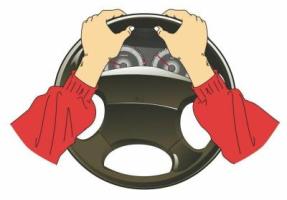
A. Right
B. Wrong
Answer:B
16. When passing through an inundated road, the driver should ________.
A. Reduce speed and go slowly
B. Maintain the normal speed and pass
C. slide over in the neutral gear
D. Speed up and pass
Answer:A
17. Whats the meaning of this sign?

A. no entering the intersection
B. no right turn
C. no changing lane
D. no U turn
Answer:B
18. What device does the switch of this symbol control?

A. window glasses of both sides
B. electric door
C. door unlock
D. child safety lock
Answer:C
19. Whats the meaning of this sign?

A. more vehicles section
B. passing slowly
C. jammed section
D. construction section
Answer:B
20. Reducing the speed when driving in sand, hail, rain, fog, ice and other weather conditions.
A. Right
B. Wrong
Answer:A
21. This sign reminds strong side wind ahead.

A. Right
B. Wrong
Answer:A
22. This traffic light means ______

A. intersection warning
B. no passing
C. draw attention
D. allow to pass
Answer:D
23. It lights to indicate that the generator is charging to the batteries.

A. Right
B. Wrong
Answer:B
24. What should the driver do if conditions permit when a following vehicle gives the overtaking signal on a road without a central line?
A. maintain the original speed
B. speed up
C. reduce speed, move to the right side and yield
D. immediately stop and yield
Answer:C
25. You may not use the turn signal when you change to the right lane.
A. Right
B. Wrong
Answer:B


