
1. When a motorized vehicle goes at night through an intersection that has no traffic lights, the driver should not use the high and low beam lights alternately.
A. Right
B. Wrong
Answer:B
2. What is the max speed when down slope, turning around and U turn?
A. 50km/hr
B. 60km/hr
C. 30km/hr
D. 40km/hr
Answer:C
3. It lights to indicate enabling the floor and the front windscreen fan.

A. Right
B. Wrong
Answer:A
4. When driving a vehicle on the road, the driver should drive safely at the prescribed speed.
A. Right
B. Wrong
Answer:A
5. When a vehicle passes a curve on a mountain road, the driver should reduce speed, honk and stick to the right.
A. Right
B. Wrong
Answer:A
6. When causing a road accident involving human casualties, the driver should immediately rescue the injured people and report to the traffic police as soon as possible.
A. Right
B. Wrong
Answer:A
7. The double yellow solid lines in the middle of the road are used to separate the traffic flow in opposite directions, crossing the lines to overtake or make a turn is allowed if it is safe.

A. Right
B. Wrong
Answer:B
8. Traffic Police can detain the accident vehicle according to law if it needs to be collected evidence of the road accident.
A. Right
B. Wrong
Answer:A
9. It displays that the current temperature of the coolant is 90 degrees.

A. Right
B. Wrong
Answer:A
10. Stopping the vehicle temporarily in the crosswalk is the act of violation of the law.
A. Right
B. Wrong
Answer:A
11. A motorized vehicle driver who uses falsified and altered license plate is subject to a ________.
A. 2-point penalty
B. 3-point penalty
C. 12-point penalty
D. 6-point penalty
Answer:C
12. When following a vehicle on the road, the distance from the vehicle in front is not important. As long as the driver goes forward at the same speed as the vehicle in front does, he can avoid rear-end collision.
A. Right
B. Wrong
Answer:B
13. Traffic Police can detain the vehicle according to law if it is without the mandatory traffic accident insurance in accordance with state regulations.
A. Right
B. Wrong
Answer:A
14. Pull down the switch of the turn signal, right-turn signal is on.

A. Right
B. Wrong
Answer:B
15. Whats the meaning of this sign?

A. accident-prone section
B. construction section
C. reducing speed and going slowly section
D. jammed section
Answer:A
16. How often should a driver who is more than 60 years old present the certificate of physical conditions?
A. every 3 years
B. every 2 years
C. every 6 months
D. every 1 year
Answer:D
17. A motorized vehicle driver who drives the vehicle which permission is different is subject to a ________.
A. 2-point penalty
B. 3-point penalty
C. 6-point penalty
D. 12-point penalty
Answer:D
18. When driving in thick or extremely thick fog, the driver should ____ due to low visibility.
A. Turn on the head light and keep driving
B. Turn on the contour light, fog light and drive along the right side
C. Turn on the hazard lights and keep driving
D. Turn on the hazard lights, fog light, and stop at a safe place
Answer:D
19. This small car can not stop here.

A. Right
B. Wrong
Answer:A
20. The behavior of a motorized vehicle driver who has violated the law and regulations on road traffic safety is _______ .
A. faulty act
B. violation of regulations
C. rule-breaking act
D. violation of law
Answer:D
21. Traffic Police can detain the vehicle according to law if it uses other vehicles license plate and vehicle license.
A. Right
B. Wrong
Answer:A
22. It displays the current engine speed is 6000 rev / min.

A. Right
B. Wrong
Answer:B
23. If one drives an illegally assembled motorized vehicle, he should not only pay the fine, but also ________ .
A. be temporarily detained the driving license
B. be revoked the driving license
C. be held for criminal liabilities
D. be detained for less than 10 days
Answer:B
24. Whats the meaning of this sign?
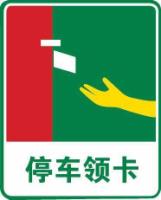
A. stop to get card
B. stop to pay
C. ETC lane
D. stop for inspection
Answer:A
25. If a motorized vehicle driver allows his vehicle to be driven by a person whose driving license has been detained, the traffic police will serve an oral warning.
A. Right
B. Wrong
Answer:B


