
1. The penalty points will be _____ if violating the traffic lights.
A. 2-point penalty
B. 3-point penalty
C. 6-point penalty
D. 12-point penalty
Answer:C
2. How to pass the intersection when running straight

A. turn on the hazard lights and pass
B. directly speed up and pass straight
C. yield to the vehicle from the right road
D. yield to the vehicle from the left road
Answer:C
3. This sign indicates one-way section ahead.

A. Right
B. Wrong
Answer:B
4. What is the Minimum speed in this lane?

A. 100km/hr
B. 110km/hr
C. 60km/hr
D. 90km/hr
Answer:D
5. Whats the meaning of this guide arrow?

A. Y-shaped intersection ahead
B. separate road ahead
C. only left or right turn ahead
D. merging with both sides ahead
Answer:C
6. Which part does it control when pulling this switch?

A. turn signals
B. reverse light
C. contour light
D. hazard light
Answer:A
7. This sign reminds there is a one-way and poor lighting culvert ahead.

A. Right
B. Wrong
Answer:B
8. It lights to indicate enabling the floor and the front windscreen fan.

A. Right
B. Wrong
Answer:A
9. Traffic Police can detain the accident vehicle according to law if it needs to be collected evidence of the road accident.
A. Right
B. Wrong
Answer:A
10. When the driver discovers a tire is leaking and steers the vehicle off the main carriageway, he should refrain from applying emergency so as to avoid a vehicle turnover or a rear-end collision arising from the late braking of the following vehicle.
A. Right
B. Wrong
Answer:A
11. To hold the steering wheel like this is correct.

A. Right
B. Wrong
Answer:B
12. The double yellow solid lines in the middle of the road are used to separate the traffic flow in opposite directions, crossing the lines to overtake or make a turn is allowed if it is safe.

A. Right
B. Wrong
Answer:B
13. What kind of marking are the double yellow solid lines in the middle of the road?

A. auxiliary marking
B. warning sign
C. prohibitive marking
D. indicative marking
Answer:C
14. Driving in a dusty weather, it does not needed to turn on the head light, the contour light and the tail light.
A. Right
B. Wrong
Answer:B
15. You have the priviledged passing right of way in this situation.

A. Right
B. Wrong
Answer:A
16. When the traffic conditions at an intersection are complicated, the driver should be patiently waiting instead of taking chance.
A. Right
B. Wrong
Answer:A
17. When driving a small vehicle downhill, the driver may coast down by stopping the engine.
A. Right
B. Wrong
Answer:B
18. When passing an intersection without traffic lights, the driver should go through as fast as possible.
A. Right
B. Wrong
Answer:B
19. It lights to indicate that engine compartment is opened.

A. Right
B. Wrong
Answer:B
20. When crossing each other at night, how far should change the high beam lights to low beam lights?
A. not need to change lights
B. beyond 150m
C. within 100m
D. within 50m
Answer:B
21. Whats the meaning of this sign?

A. no going straight and no changing to left lane
B. no going straight and no left turn
C. allowed to go straight and change to left lane
D. no going straight and no right turn
Answer:D
22. Whats the meaning of this sign?

A. continuous down slopes
B. steep downhill road
C. steep uphill road
D. continuous up slopes
Answer:A
23. What kind of violation does this stopping car have?

A. stop occupying the lane for non-motorized vehicles
B. stop in the section with no stopping marking
C. stop at bus station
D. stop occupying sidewalk
Answer:C
24. Whats the meaning of this sign?
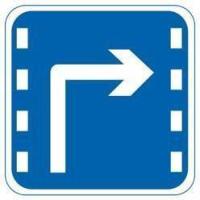
A. right-turn lane
B. U turn lane
C. left-turn lane
D. lanes for going in different directions
Answer:A
25. When a vehicle follows another vehicle on a mountain road, it should ____.
A. Properly increase the safe distance
B. Closely follow the vehicle in front
C. Properly reduce the safe distance
D. Try to find a chance to overtake
Answer:A


