
1. This motorized vehicle parked on the roadside has no illegal act.

A. Right
B. Wrong
Answer:B
2. In such road sections, you can enter the cross-hatched marking area to wait.

A. Right
B. Wrong
Answer:B
3. A vehicle may stop on the ramp of an expressway.
A. Right
B. Wrong
Answer:B
4. Whats the meaning of the white rectangle marking?

A. special space for taxicabs to take and drop passengers
B. horizontal parking space
C. inclined parking space
D. vertical parking space
Answer:B
5. It lights to indicate that ______

A. charge current is too large
B. damaged battery
C. ammeter malfunction
D. charging circuit malfunction
Answer:D
6. How to pass this intersection?

A. not reduce speed to pass
B. speed up to pass as soon as possible
C. slide over in the neutral gear
D. reduce speed or stop to observe
Answer:D
7. Traffic Police can detain the driver according to law, if the driver drives a motorized vehicle which is suspected of reaching the write-off standard.
A. Right
B. Wrong
Answer:B
8. Whats the meaning of this sign?
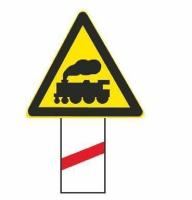
A. an unmanned level crossing 100m ahead
B. a manned level crossing 100m ahead
C. an unmanned level crossing 50m ahead
D. a manned level crossing 50m ahead
Answer:C
9. What marking is the combination of the white broken lines and the triangle area?

A. road entry marking
B. lane-dividing line that can be crossed
C. deceleration line at road entry
D. road exit marking
Answer:A
10. What should a motorized vehicle has while running on the road?
A. a label of keeping distance
B. a label of reminding danger
C. a label of inspection
D. a label of product qualification
Answer:C
11. You have the priviledged passing right of way in this situation.

A. Right
B. Wrong
Answer:A
12. Whats the meaning of the white solid line in the middle of the road?
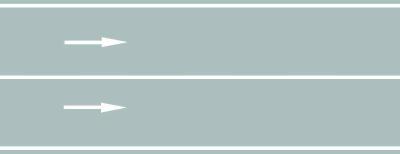
A. unilateral same direction lanes dividing line that can be crossed
B. same direction lanes dividing line that can not be crossed
C. bilateral same direction lanes dividing line that can be crossed
D. opposite direction lanes dividing line that can not be crossed
Answer:B
13. Displays the current speed is 20 km / h

A. Right
B. Wrong
Answer:B
14. How to pass when encountering this situation at the intersection?

A. make sure it is safe to pass
B. turn right and speed up to pass
C. speed up and pass straight
D. turn left and speed up to pass
Answer:A
15. Whats the meaning of this sign?

A. right-turn lane
B. U turn lane
C. left-turn lane
D. straight-going lane
Answer:D
16. The braking system may malfunction if it lights.

A. Right
B. Wrong
Answer:A
17. If the drivers household register has moved out of the original vehicle management station, the driver should apply to the vehicle management station _______ .
A. At the former place of his household register
B. At the residential place
C. At the new place of his household register
D. At the location of his household register
Answer:C
18. ABS system can maximize the braking efficiency when conducting _______
A. braking intermittently
B. braking continuously
C. applying emergency braking
D. gently depressing the brake pedal
Answer:C
19. You should speed up to change lane in front of the red car.

A. Right
B. Wrong
Answer:B
20. These signs warn the driver danger ahead and passing with care.

A. Right
B. Wrong
Answer:A
21. When driving a small vehicle downhill, the driver may coast down by stopping the engine.
A. Right
B. Wrong
Answer:B
22. When a vehicle approaches an intersection without crosswalk, the driver should _______ if he finds people are crossing the street.
A. Reduce speed or stop to yield
B. Honk to indicate them to yield
C. Immediately change lane and bypass the pedestrians
D. Pass before the pedestrians
Answer:A
23. When the traffic conditions at an intersection are complicated, the driver should be patiently waiting instead of taking chance.
A. Right
B. Wrong
Answer:A
24. The vehicle with ABS system can minimize the braking distance when driving on a road covered by ice and snow.
A. Right
B. Wrong
Answer:B
25. When a vehicle wades across the water, the driver should maintain a low speed, and _____ the brake pedal so as to restore the braking efficiency.
A. Continuously and strongly depress
B. Intermittently and strongly depress
C. Continuously and gently depress
D. Intermittently and gently depress
Answer:D


