
1. Which of the following vehicle in front in the same lane is not allowed to be overtaken?
A. police car on duty
B. large bus or large truck
C. taxis
D. public bus
Answer:A
2. After a vehicle enters the ramp, the driver should swiftly increase the speed to more than 60 kilometers per hour.
A. Right
B. Wrong
Answer:B
3. Top speed in this section is 50 kilometers per hour.

A. Right
B. Wrong
Answer:B
4. If the registration paper, license plate and vehicle license of a motorized vehicle are lost or destroyed, the vehicle owner should apply for reissuing or replacing them to the vehicle management station at the residential place.
A. Right
B. Wrong
Answer:B
5. You may not use the turn signal when you change to the right lane.
A. Right
B. Wrong
Answer:B
6. Whats the meaning of this sign?

A. no left turn
B. dead-end road
C. no passing
D. bypass if overheight
Answer:D
7. A driver should buckled up before the vehicle moves.
A. Right
B. Wrong
Answer:A
8. The method of this small passenger vehicle to leave the expressway lane is correct.

A. Right
B. Wrong
Answer:A
9. This sign reminds the width of the bridge narrows ahead.

A. Right
B. Wrong
Answer:B
10. A motorized vehicle driver who drives after drinking is subject to a 12-point penalty.
A. Right
B. Wrong
Answer:A
11. A motorized vehicle driver who illegally occupies the emergency lane on the expressway is subject to a 6-point penalty.
A. Right
B. Wrong
Answer:A
12. When a vehicle encounters a bike rider coming in the opposite direction on the road, the driver should _________.
A. Continuously change the high and low bean lights
B. Continuously honk
C. Use the low beam light, reduce speed or stop to evade
D. Use the high beam light
Answer:C
13. It lights to indicate that ______

A. the tail fog light is turned on
B. the low beam light is turned on
C. the high beam light is turned on
D. the head fog light is turned on
Answer:B
14. Driving a motorized vehicle on the highway which has no central line, the maximum speed can not exceed 70 kilometers per hour.
A. Right
B. Wrong
Answer:B
15. Whats the meaning of this sign?
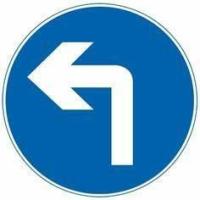
A. turn left
B. no going straight
C. straight-going lane
D. one-way road
Answer:A
16. When a vehicle goes downhill, the driver should properly control the speed and fully use the engine to brake.
A. Right
B. Wrong
Answer:A
17. Whats the meaning of this sign?

A. watch for long time honking
B. an unmanned level crossing
C. a manned level crossing
D. multi-crossing of railway and road
Answer:B
18. What markings are the two double yellow broken lines on the road?

A. two-way lanes dividing line
B. variable lane line
C. lane-dividing line that can be crossed
D. one-way lanes dividing line
Answer:B
19. Whats the meaning of this guide arrow?

A. going straight or U turn
B. going straight or left turn
C. going straight or changing to left lane
D. left turn or U turn
Answer:B
20. What marking is the yellow road surface in the center of the intersection?

A. central circle
B. guide line
C. cross-hatched marking
D. parking area
Answer:C
21. When a vehicle merges with the traffic flow, the driver should turn on the turn signal in advance, go straight, observe the traffic conditions on both sides through the rear-view mirror, and merge with the traffic flow if it is safe to do so.
A. Right
B. Wrong
Answer:A
22. Whats the meaning of this sign?

A. sharp right curve
B. bypass from right side
C. continuous curves
D. sharp left curve
Answer:A
23. What is the role of ABS system when applying emergency braking?

A. cut off the power output
B. control the direction automatically
C. reduce braking inertia
D. prevent wheel blocking
Answer:D
24. After starting the engine, it lights to indicate that ______

A. engine main oil way blockage
B. engine oil pressure is too low
C. engine crankshaft box leaks
D. engine oil pressure is too high
Answer:B
25. What causes the rear-end collision?

A. not observe through the rear-view mirror while the vehicle in front brakes
B. the vehicle in front brakes suddenly
C. distance from the vehicle in front is too close when the rear vehicle overtakes
D. not maintain a safe distance from the vehicle in front
Answer:D


