
1. Cannot make a U turn in this section.

A. Right
B. Wrong
Answer:A
2. When encountering an ambulance rushing in the same lane in the opposite direction, the driver should ________.
A. Move to the road side, reduce speed or stop to yield
B. Drive on by using another lane
C. Speed up and change lane to avoid
D. Continue to go in the original lane
Answer:A
3. When driving at night, the driver should reduce speed and go forward if the vehicle coming in the opposite direction fails to turn off the high beam light. This is designed to prevent an accident from happening when there are pedestrians crossing the place where the lights of the two vehicles meet.
A. Right
B. Wrong
Answer:A
4. At this position, the motorized vehicle can continue to go through if the front wheels have passed the stop line.

A. Right
B. Wrong
Answer:B
5. Whats the meaning of this sign?

A. the lane for non-motorized vehicles
B. yield non-motorized vehicles
C. no passing for non-motorized vehicles
D. watch for non-motorized vehicles
Answer:D
6. When a motorized vehicle stops temporarily at the roadside, the driver ________.
A. Is not allowed to stop in the opposite direction or in parallel
B. May stop anyway he likes as long as it is convenient for him to get out
C. May stop the vehicle in the opposite direction
D. May stop the vehicle in parallel
Answer:A
7. The main impact of the road conditions at night on safe driving is ________.
A. The visibility is low and unfavorable for observing road traffic conditions
B. The road surface is complex and changing
C. The physical strength of the driver decreases
D. The driver can easily have impulse and illusion
Answer:A
8. It lights to indicate that ______

A. the floor and the front fans work
B. air internal circulation
C. air external circulation
D. the side and the floor fans work
Answer:A
9. When braking on a muddy road, the tires can easily spin or drift and cause traffic accidents.
A. Right
B. Wrong
Answer:A
10. When a vehicle running at night encounters a curve ahead, its lighting ____.
A. Leave the road surface
B. Moves from the center of the road to the roadside
C. Does not change its distance
D. Become lower
Answer:B
11. When driving in thick or extremely thick fog, the driver should ____ due to low visibility.
A. Turn on the head light and keep driving
B. Turn on the contour light, fog light and drive along the right side
C. Turn on the hazard lights and keep driving
D. Turn on the hazard lights, fog light, and stop at a safe place
Answer:D
12. No U turn at this section.

A. Right
B. Wrong
Answer:B
13. Use the high and low beam lights alternately when passing the crosswalk at night.
A. Right
B. Wrong
Answer:A
14. At night, the drivers observation is markedly poorer than in the daytime and the range of visibility range is _______.
A. Unchanged
B. Irregular
C. Longer
D. Shorter
Answer:D
15. Whats the meaning of this sign?
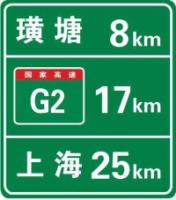
A. indication of the place name of the expressway ending
B. indication of the driving route of the expressway
C. indication of the driving direction of the expressway
D. indication of the location and distance of the expressway
Answer:D
16. Whats the meaning of this sign?

A. line guide signs
B. lane merging guide signs
C. lane branching guide signs
D. turning guide signs
Answer:A
17. The driving license of 10-year validity will be issued if the penalty points never reached 12 points in every scoring cycle during the 6-year validity of the license.
A. Right
B. Wrong
Answer:A
18. The yellow lane-dividing line in the picture is used to separate the traffic flow in opposite directions, crossing the line to overtake or make a turn is allowed if it is safe.

A. Right
B. Wrong
Answer:A
19. If a vehicle enters a left lane for overtaking but is unable to ensure a safe horizontal distance with the normally-running vehicle in front, the driver should ________.
A. Speed up and overtake
B. Overtake after running a distance in parallel
C. Give up overtaking
D. Overtake with care
Answer:C
20. Whats the meaning of the marking in the red circle?

A. temporary stopping
B. bay-stopping
C. emergency stopping
D. public bus station
Answer:B
21. This set of the hand signals of the traffic police indicates that the vehicles should ___ .

A. go straight
B. make a turn
C. stop
D. pull over
Answer:A
22. Reducing the speed to yield when encountering this situation in the intersection.

A. Right
B. Wrong
Answer:A
23. Whats the meaning of this sign?

A. pass with low speed
B. watch for pedestrians
C. on foot
D. pedestrians go first
Answer:C
24. If a motorized vehicle driver allows his vehicle to be driven by a person whose driving license has been revoked, the traffic police will detain the driving license.
A. Right
B. Wrong
Answer:A
25. When reaching a sharp curve, the driver should reduce speed and drive on the right side so as to avoid colliding with the vehicle crossing the central line of the curve in the opposite direction.
A. Right
B. Wrong
Answer:A


