
1. Whats the meaning of this sign?

A. passing by the right side
B. passing by the left side
C. running to right side
D. running the roundabout
Answer:D
2. When driving on a mountain road covered by ice and snow, the vehicle behind should ______ if the vehicle in front is climbing a slope.
A. Climb slowly
B. Closely follow and climb
C. Select a proper place to stop and climb after the vehicle in front has passed
D. Rapidly overtake the vehicle in front
Answer:C
3. When following a vehicle, the following vehicle may use the high beam light.
A. Right
B. Wrong
Answer:B
4. After causing a road accident, the vehicle driver needs to change the scene for rescuing the wounded, the driver should mark the location.
A. Right
B. Wrong
Answer:A
5. If a front tire blowout has caused a turn in direction, the driver should not avoid excess adjustment. Instead, he should control the direction of the vehicle, ____, and slowly reduce the speed of the vehicle.
A. Apply emergency braking
B. Use the handbrake
C. Gently depress the brake pedal
D. Swiftly depress the brake pedal
Answer:C
6. Whats the meaning of this sign?

A. special lane for large buses
B. special lane for public buses
C. special lane for Bus Rapid Transit System
D. special lane for multi-passenger vehicles
Answer:B
7. Whats the meaning of this sign?

A. recommended speed in unusual weather
B. minimum speed in unusual weather
C. average speed in unusual weather
D. maximum speed in unusual weather
Answer:A
8. Whats the meaning of this sign?

A. line guide signs
B. lane merging guide signs
C. lane branching guide signs
D. turning guide signs
Answer:A
9. It lights when turning on the front high beam lights.

A. Right
B. Wrong
Answer:B
10. From which side to overtake?

A. both sides
B. right side
C. left side
D. the side with no obstacle
Answer:C
11. This sign indicates obstacle ahead and bypassing from left side.

A. Right
B. Wrong
Answer:A
12. Whats the meaning of this guide arrow?

A. going straight and U turn are allowed ahead
B. left turn and U turn are allowed ahead
C. going straight and changing to left lane are allowed ahead
D. going straight and left turn are allowed ahead
Answer:B
13. You should speed up to go through the railway crossing in this case.

A. Right
B. Wrong
Answer:B
14. When a vehicle leaves an expressway, it should reduce speed in the deceleration lane before entering the ramp.
A. Right
B. Wrong
Answer:A
15. Whats the meaning of this sign?
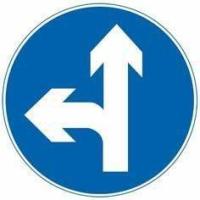
A. going straight and right turn
B. going straight and left turn
C. no going straight and no left turn
D. right turn and left turn only
Answer:B
16. If the drivers household register has moved out of the original vehicle management station, the driver should apply to the vehicle management station _______ .
A. At the former place of his household register
B. At the residential place
C. At the new place of his household register
D. At the location of his household register
Answer:C
17. Whats the meaning of this sign?

A. the lane for non-motorized vehicles
B. yield non-motorized vehicles
C. no passing for non-motorized vehicles
D. watch for non-motorized vehicles
Answer:D
18. How far should be the distance from the vehicle in front at the speed of more than 100 km/hr when driving a small passenger vehicle on the expressway?
A. more than 50 meters
B. more than 60 meters
C. more than 100 meters
D. more than 80 meters
Answer:C
19. What is this traffic sign?

A. Road narrows on both sides
B. Road narrows on the right side
C. Road narrows on the left side
D. Bridge narrows
Answer:A
20. Whats the meaning of this sign?

A. danger-avoiding lane
B. emergency lane
C. road shoulder
D. sharp curve
Answer:A
21. This sign reminds a sharp curve ahead.

A. Right
B. Wrong
Answer:B
22. Which lane to choose when turning left in this intersection?

A. the far left lane
B. middle lane
C. not need to change lane
D. the far right lane
Answer:A
23. When running on an expressway that has four lanes in the same direction, the vehicles whose speed is higher than 110 kilometers per hour should run ______.
A. The far left lane
B. The second left lane
C. The far right lane
D. The third left lane
Answer:A
24. This sign means the opposite vehicle should stop to yield when crossing each other.

A. Right
B. Wrong
Answer:B
25. When overtaking, the driver should ________ if the vehicle in front refuses to reduce speed or yield.
A. Follow closely and find chance to overtake again
B. Stop overtaking
C. Speed up and continue to overtake
D. Continuously honk and speed up to overtake
Answer:B


