
1. When a motorized vehicle breaks down on the road and is difficult to move, the driver should place a warning sign within 50 meters behind the vehicle.
A. Right
B. Wrong
Answer:B
2. What marking is it?

A. A cross-hatched marking
B. prohibitive area
C. guide line
D. central circle
Answer:D
3. The validity of the driving license which is initially applied for is 6 years.
A. Right
B. Wrong
Answer:A
4. If the registration paper, license plate and vehicle license of a motorized vehicle are lost or destroyed, the vehicle owner should apply for reissuing or replacing them to the _______________.
A. traffic police detachment vehicle management station at the residential place
B. vehicle management station at the issuing place of the driving license
C. vehicle management station at the registration place
D. local police station
Answer:C
5. What pedal is it?

A. accelerator pedal
B. clutch pedal
C. handbrake
D. the brake pedal
Answer:A
6. This sign reminds strong side wind ahead.

A. Right
B. Wrong
Answer:A
7. Whats the meaning of this sign?

A. stop to yield
B. no stopping temporarily
C. no entry
D. no long stopping
Answer:A
8. What is the max speed on this highway?

A. 30km/hr
B. 40km/hr
C. 50km/hr
D. 70km/hr
Answer:D
9. Whats the meaning of this sign?

A. muddy road
B. low-lying road
C. overflowing road
D. ferry
Answer:C
10. At night, the drivers observation is markedly poorer than in the daytime and the range of visibility range is _______.
A. Unchanged
B. Irregular
C. Longer
D. Shorter
Answer:D
11. When reversing on an ordinary road and discovering some vehicles are passing, the driver should _________.
A. Honk to indicate the intention
B. Voluntarily stop and yield
C. Speed up and reverse
D. Continue to reverse
Answer:B
12. When a vehicle stops temporarily in a snowy day, the driver should turn on _______.
A. The head and tail fog light
B. The reserve light
C. The high beam light
D. The hazard lights
Answer:D
13. A motorized vehicle is not allowed to stop in the section 50 meters to the bridge, steep slope or tunnel.
A. Right
B. Wrong
Answer:A
14. It displays that oil in tank has less than the warning line

A. Right
B. Wrong
Answer:A
15. The continuously flashing yellow light means that the vehicle may speed up and pass.
A. Right
B. Wrong
Answer:B
16. When encountering a traffic accident ahead and help is needed while driving, the driver should ________.
A. Bypass to dodge it as much as possible
B. Immediately report to the police, stop and look on.
C. Help to preserve the scene and immediately report to the police
D. Speed up and pass to ignore it
Answer:C
17. When a vehicle goes down a long slope, it should run at a lower gear and fully use the engine to brake.
A. Right
B. Wrong
Answer:A
18. Whats the meaning of this sign?
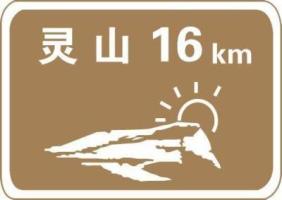
A. distance to a tourist area
B. direction of a tourist area
C. symbol of a tourist area
D. category of a tourist area
Answer:A
19. Continuously using the foot brake on a long downhill road ________.
A. Can shorten the engines service life
B. Increases the drivers labor intensity
C. Can drastically reduce the braking efficiency due to the rising temperature of the brake
D. Can easily cause vehicle overturn
Answer:C
20. The driver who chases and races while driving on the road, and commits serious acts is subject to ______
A. a prison term of 6 months
B. a prison term of more than 1 year
C. a criminal restriction and a fine
D. a criminal detention and a fine
Answer:D
21. Honking in a foggy day can arouse the attention of the opposite side. After hearing the honking from the opposite side, the driver should also honk to respond.
A. Right
B. Wrong
Answer:A
22. Whats the meaning of this sign?

A. stop by the left side of the road
B. downhill section left
C. left turn only
D. run by the left side of the road
Answer:D
23. It lights to indicate that right door is not closed.

A. Right
B. Wrong
Answer:B
24. Displays the current speed is 20 km / h

A. Right
B. Wrong
Answer:B
25. When the green arrow for a lane is on and there are still pedestrians in the crosswalk before the vehicle, the driver should ___________.
A. Directly start up and pass
B. Start up and bypass the pedestrians from behind
C. Start up and bypass before the pedestrians
D. Start up after the pedestrians have passed
Answer:D


