
1. When reversing on an ordinary road and discovering some vehicles are passing, the driver should _________.
A. Honk to indicate the intention
B. Voluntarily stop and yield
C. Speed up and reverse
D. Continue to reverse
Answer:B
2. How long is the period of probation after a motorized vehicle driver obtains his driving license for the first time or the permission to drive higher level vehicles.
A. 6 months
B. 12 months
C. 2 years
D. 3 months
Answer:B
3. Driving a small passenger vehicle on the expressway, the minimum speed should not be less than 90 kilometers per hour.
A. Right
B. Wrong
Answer:B
4. When running on the road having maximum speed limit signs, the motorized vehicle is not allowed to exceed the marked maximum speed.
A. Right
B. Wrong
Answer:A
5. Illegally assembled motorized vehicle can be drived on road as long as it is thought to be safe.
A. Right
B. Wrong
Answer:B
6. May not drive if _____
A. the window is not closed
B. the door is not closed
C. the audio device is not closed
D. the roof window is not closed
Answer:B
7. If a motorized vehicle driver escapes after causing a major traffic accident which has caused human death, the driver is subject to a prison term of ________.
A. more than 7 years
B. less than 3 years
C. 3 ~ 7 years
D. more than 10 years
Answer:C
8. This sign reminds a sharp curve ahead.
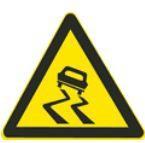
A. Right
B. Wrong
Answer:B
9. What is the max speed when down slope, turning around and U turn?
A. 50km/hr
B. 60km/hr
C. 30km/hr
D. 40km/hr
Answer:C
10. Whats the meaning of this sign?
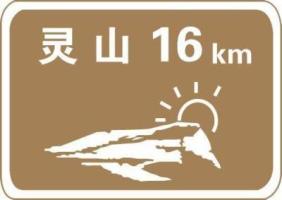
A. distance to a tourist area
B. direction of a tourist area
C. symbol of a tourist area
D. category of a tourist area
Answer:A
11. The validity of the driving license which is initially applied for is 4 years.
A. Right
B. Wrong
Answer:B
12. When driving at night, the driver should go at a lower speed because his field of vision is limited and he can hardly observe the traffic conditions beyond the area covered by his vehicle light.
A. Right
B. Wrong
Answer:A
13. A motorized vehicle runs on the road without a label of insurance, the traffic police can detain the vehicle license according to law.
A. Right
B. Wrong
Answer:B
14. Whats the meaning of this sign?
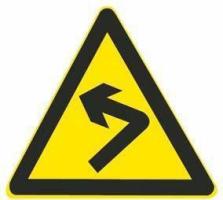
A. bypass from left side
B. continuous curves
C. sharp left curve
D. sharp right curve
Answer:C
15. Traffic markings are divided into indication, warning and prohibition.
A. Right
B. Wrong
Answer:A
16. When a vehicle passes a sharp curve, it may overtake if traffic is light.
A. Right
B. Wrong
Answer:B
17. When driving, the driver should be courteous and defensive, instead of being offensive.
A. Right
B. Wrong
Answer:A
18. When encountering slow-moving vehicles at an intersection that has no traffic signals, the motorized vehicle should pass alternately.
A. Right
B. Wrong
Answer:A
19. Whats the meaning of the yellow broken and solid lines in the middle of the road?
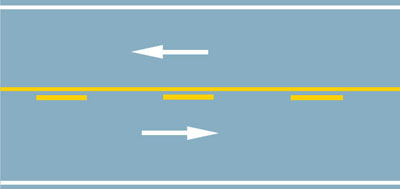
A. no crossing the lines on the side of the broken line
B. no crossing the lines on the side of the solid line
C. allowed to cross the lines on the side of the solid line
D. allowed to cross the lines on both sides
Answer:B
20. Whats the meaning of this sign?
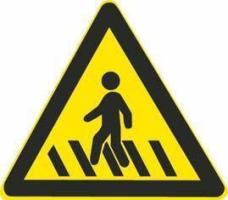
A. watch for pedestrians
B. watch for children
C. school area
D. crosswalk
Answer:A
21. In which situation the traffic police may detain the vehicle?
A. no lable of inspection
B. no ID card
C. no lable of environmental protection
D. no vehicle registration papers
Answer:A
22. Which should be taken along while driving?
A. vocational qualification certificate
B. ID card
C. driving license
D. work permits
Answer:C
23. The police can detain the vehicle if one drives a vehicle without ______
A. driving license
B. ID card
C. pass paper
D. qualification certificate
Answer:A
24. Stop and yield to the pedestrians under this situation.
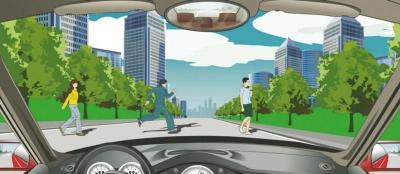
A. Right
B. Wrong
Answer:A
25. What should a motorized vehicle has while running on the road?
A. a label of keeping distance
B. a label of reminding danger
C. a label of inspection
D. a label of product qualification
Answer:C


