
现在车辆管理所摩托车英语题库为全中国统一版本,都是考一样的试题,2025年摩托车DEF驾照英语科目一共400题,科目四345题,以下为样题:
1. When a motorcycle wades across the water, the braking efficiency of the brake does not change.
A. Right
B. Wrong
Answer:B
2. Which illegal conduct is subject to a 12-point penalty?
A. violate traffic lights
B. use falsified license plate
C. call or answer the mobile phone
D. violate prohibitive signs
Answer:B
3. A person who falsifies, alters driving license or uses falsified, altered driving license, and if his act constitutes a crime, he should be held for criminal liabilities according to law.
A. Right
B. Wrong
Answer:A
4. When a motorized vehicle makes a U turn, turns around or goes down a slope, the maximum speed should not exceed 40 kilometers per hour.
A. Right
B. Wrong
Answer:B
5. Turn on the left-turn signal in advance when making a U turn on the road.
A. Right
B. Wrong
Answer:A
6. How to ensure motor vehicles have sufficient power when driving uphill?
A. Downshift before reducing speed
B. Downshift after reducing speed
C. Downshift when the speed is excessively low
D. Downshift to the fullest extent
Answer:A
7. What is the max speed when visibility is less than 50m due to foggy, rainy or snowy?
A. 70km/hr
B. 50km/hr
C. 40km/hr
D. 30km/hr
Answer:D
8. Motor vehicle drivers may borrow a special lane for other vehicle types, if one exists, to overtake.
A. Right
B. Wrong
Answer:B
9. When encountering a vehicle in front ascending on a mountainous road covered with ice and snow, what should the motor vehicle driver do?
A. Ascend after the vehicle in front passes the slope
B. Overtake the vehicle in front swiftly and drive on
C. Overtake the vehicle in front with a slow speed and drive on
D. Follow the vehicle in front closely
Answer:A
10. What is the max speed on muddy road?
A. 15km/hr
B. 20km/hr
C. 40km/hr
D. 30km/hr
Answer:D
11. It is illegal to change lanes without turning on indicators.
A. Right
B. Wrong
Answer:A
12. The main impact of muddy roads on safe driving is that the wheels may easily spin and skid
A. Right
B. Wrong
Answer:A
13. What is the max speed when passing a level crossing?
A. 15km/hr
B. 20km/hr
C. 30km/hr
D. 40km/hr
Answer:C
14. In which situation the traffic police can detain the vehicle according to law?
A. exceeding 10% of the prescribed speed limits
B. driving wen he is exhausted
C. not buckled up while driving
D. driving after drinking
Answer:D
15. When driving on a damp and slippery road, drivers should avoid using the emergency brake to his/her best ability.
A. Right
B. Wrong
Answer:A
16. If a motorized vehicle runs 50% faster than the specified speed limit, the driver is subject to a 3-point penalty.
A. Right
B. Wrong
Answer:B
17. In which situation the traffic police may detain the vehicle?
A. no lable of inspection
B. no ID card
C. no lable of environmental protection
D. no vehicle registration papers
Answer:A
18. When a tire blowout on the road, the driver should control the direction of the vehicle and use emergency braking to bring the motorcycle swiftly to a stop.
A. Right
B. Wrong
Answer:B
19. How to choose parking spot when needing to stop by the roadside?
A. stop in the opposite direction by the left roadside
B. stop in the parking area
C. stop anywhere as will by the roadside
D. stop in the sidewalk
Answer:B
20. What is the meaning of this sign?
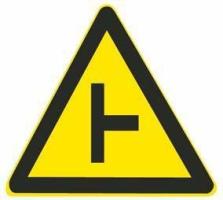
A. Y-shaped intersection
B. T-shaped intersection
C. intersection
D. ring intersection
Answer:B
21. Turning on the high-beam is an effective way to improve visibility in fog weather.
A. Right
B. Wrong
Answer:B
22. When running in a high speed, if only use the front brake, the driver can be easily thrown out due to the inertia.
A. Right
B. Wrong
Answer:A
23. When encountering slow-moving vehicles at an intersection that has no traffic signals, the motorized vehicle should pass alternately.
A. Right
B. Wrong
Answer:A
24. What is the meaning of this sign?
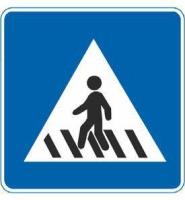
A. crosswalk
B. students’ passage
C. watch for pedestrians
D. children’s passage
Answer:A
25. How should lamps be used when a motor vehicle meets an oncoming bicycle on a narrow road or a narrow bridge at night?
A. Continuously change between low-beam and high-beam
B. Use clearance lamp
C. Use high-beam
D. Use low-beam
Answer:D


