
现在车辆管理所摩托车英语题库为全中国统一版本,都是考一样的试题,2025年摩托车DEF驾照英语科目一共400题,科目四345题,以下为样题:
1. Which is correct when changing lane?
A. turn on the directional signal and turn left quickly
B. reduce speed properly when entering the left lane
C. cannot interfere other vehicles
D. speed up to enter the left lane
Answer:C
2. If a person who has caused a major traffic accident and if his act constitutes a crime, he may not be held for criminal liabilities.
A. Right
B. Wrong
Answer:B
3. When driving into the traffic flow on a main road from a relief road, drivers should speed up.
A. Right
B. Wrong
Answer:B
4. When a motor vehicle passes over an overflowing bridge, what should the driver do after stopping and observing closely?
A. Change to a high gear and pass rapidly
B. Constantly observe the changes of the flow
C. Prepare to stop at any time
D. Change to a low gear and pass through at a constant speed
Answer:D
5. A light motorcycle is only permitted to carry preschoolers.
A. Right
B. Wrong
Answer:B
6. A driver may drive a motorized vehicle after the driving license has been lost within 3 months.
A. Right
B. Wrong
Answer:B
7. When a motorcycle reaches a muddy or burst-and-muddy section, the driver should stop, observe and select the level and solid section or the section with vehicle tracks.
A. Right
B. Wrong
Answer:A
8. Which of the following vehicle in front in the same lane is not allowed to be overtaken?
A. large truck
B. fire engine on duty
C. public bus
D. large bus
Answer:B
9. When a motorized vehicle runs in a foggy weather, the driver should turn on the fog light and the hazard lights.
A. Right
B. Wrong
Answer:A
10. When a motorized vehicle breaks down on the road and is difficult to move, the driver should place a warning sign within 50 meters behind the vehicle.
A. Right
B. Wrong
Answer:B
11. When a tire bursts suddenly on the road, the driver should refrain from violently depressing the brake pedal in panic. Instead, he/she should try his/her best to change to a low gear and use engine braking to reduce the speed of the vehicle.
A. Right
B. Wrong
Answer:A
12. When approaching a vehicle on a narrow slope, which one of the following ways is correct?
A. The descending vehicle yields to the ascending
B. The vehicle which is further from the slope crest should yield
C. The ascending vehicle yields to the descending
D. If the descending vehicle has reached the midpoint while the ascending vehicle has not yet set out, the descending vehicle must yield.
Answer:A
13. A motorized vehicle is not allowed to stop in the section 50 meters to the narrow road less than 4 meters width.
A. Right
B. Wrong
Answer:A
14. A motorized vehicle that will turn right at an intersection but has a vehicle in front in the same lane waiting for the green light should ______________.
A. Stop and wait for his turn
B. Honk to indicate the vehicle in front to yield
C. Bypass the vehicle in front from the right side and go through the intersection
D. Bypass the vehicle in front from the left side and go through the intersection
Answer:A
15. When approaching another vehicle at night, why should the driver alternate between high-and-low-beam at a distance more than 150 meters?
A. Warn each other before passing
B. Driving habit
C. Easy to observe the situation ahead from either side
D. Courtesy
Answer:C
16. How should lamps be used by the motor vehicle driver who follows a vehicle on a road section at night where he street light condition is good?
A. Turn off the headlamp
B. Use high-beam
C. Turn off all lamps
D. Use low-beam
Answer:D
17. When a motorcycle goes downhill on a mountain road, it is not allowed to overtake.
A. Right
B. Wrong
Answer:A
18. When causing a road accident involving property damage, the party should leave the scene on his own but he does not leave, the traffic police can not order him to leave.
A. Right
B. Wrong
Answer:B
19. A motorized vehicle is not allowed to stop in the section 50 meters to the bridge, steep slope or tunnel.
A. Right
B. Wrong
Answer:A
20. In which situation the traffic police may detain the vehicle?
A. no lable of inspection
B. no ID card
C. no lable of environmental protection
D. no vehicle registration papers
Answer:A
21. If a driver finds there is no vehicle behind, he/she may change lanes without turning on the indicator.
A. Right
B. Wrong
Answer:B
22. What should the driver do when encountering a vehicle from the opposite direction on a road without a central line?
A. driving closly by the roadside
B. driving by the central of the road
C. reducing speed and driving by right side
D. run by using the lane for non-motorized vehicles
Answer:C
23. If the driver’s household register has moved out of the original vehicle management station, the driver should apply to the vehicle management station _______ .
A. At the former place of his household register
B. At the residential place
C. At the new place of his household register
D. At the location of his household register
Answer:C
24. Sounding the horn on a foggy daY can arouse the attention of the opposite side. After hearing the horn from the opposite side, the driver should also sound their own horn to respond.
A. Right
B. Wrong
Answer:A
25. What is the meaning of this sign?
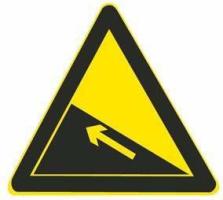
A. steep downhill road
B. continuous up slopes
C. steep uphill road
D. embankment road
Answer:C


