
1. Move the turn signal switch upward, the left-turn signal lights.

A. Right
B. Wrong
Answer:B
2. How to pass when encountering this situation at the intersection?

A. make sure it is safe to pass
B. turn right and speed up to pass
C. speed up and pass straight
D. turn left and speed up to pass
Answer:A
3. Which kind of sign is it?

A. warning sign
B. directional sign
C. indicative sign
D. prohibitive sign
Answer:A
4. This sign reminds serious bump road ahead.

A. Right
B. Wrong
Answer:B
5. When driving a motor vehicle after drinking, a prison term of more than 3 years will be imposed.
A. Right
B. Wrong
Answer:B
6. How far should be the distance from the vehicle in front at the speed of more than 100 km/hr when driving a small passenger vehicle on the expressway?
A. more than 50 meters
B. more than 60 meters
C. more than 100 meters
D. more than 80 meters
Answer:C
7. If a vehicle has the right of way at an intersection but encounters a vehicle cutting in, the driver should _________.
A. Rush to pass
B. Speed up in advance and pass
C. Reduce speed and evade, or stop to yield when necessary
D. Go forward at the normal speed according to the right of way and refuses to evade
Answer:C
8. Before entering a level crossing, the vehicle should reduce speed and change to a lower gear, and _____ after entering the level crossing.
A. Cannot change gear
B. Can change gear
C. Can change to a higher gear
D. Stop and look
Answer:A
9. Whats the meaning of this sign?

A. minimum speed limit is 50km/hr
B. maximum speed limit is 50km/hr
C. the height is 50m
D. the altitude is 50m
Answer:A
10. When encountering an ambulance rushing in the same lane in the opposite direction, the driver should ________.
A. Move to the road side, reduce speed or stop to yield
B. Drive on by using another lane
C. Speed up and change lane to avoid
D. Continue to go in the original lane
Answer:A
11. How to drive in sand, hail, rain, fog, ice and other weather conditions?
A. run as normal
B. maintain the speed
C. speed up properly
D. reduce the speed
Answer:D
12. How to use lights in this weather condition?

A. use high beam lights
B. use fog lights
C. not use any light
D. turn on the right-turn signal
Answer:B
13. What is the max speed on the expressway when the visibility is lower than 200m?
A. less than 100km/hr
B. less than 90km/hr
C. less than 60km/hr
D. less than 80km/hr
Answer:C
14. If a motorized vehicle driver has caused a major traffic accident in violation of the traffic regulations which has caused human death due to his escaping, the driver is subject to a prison term of 3 years ~ 7 years.
A. Right
B. Wrong
Answer:B
15. In this case, by the right side of the bus lane to overtake.

A. Right
B. Wrong
Answer:B
16. The main impact of mountain roads on safe driving is _______.
A. The traffic conditions are boring
B. The slopes are long, the curves are sharp and visibility range is shorter.
C. The traffic flow is heavy
D. The road signs are fewer
Answer:B
17. The red car can run in this lane.

A. Right
B. Wrong
Answer:B
18. If a motorized vehicle has reached the states mandatory write-off standard, its registration will not be handled.
A. Right
B. Wrong
Answer:A
19. How to cross each other on a narrow mountain road without the central dividing line?
A. The vehicle not close to the mountain goes first
B. The vehicle close to the mountain goes first
C. The empty vehicle goes first
D. The slow-moving vehicle goes first
Answer:A
20. Whats the meaning of the yellow marking on the road?

A. gradual road width
B. more carriageways
C. closing to obstacle
D. construction section indication
Answer:A
21. When the two red lights at a level crossing flash alternately, the vehicles should stop to wait.

A. Right
B. Wrong
Answer:A
22. If a driver has driven a motorized vehicle for more than four hours running, he should stop the vehicle and rest for at least ____________.
A. 10 minutes
B. 15 minutes
C. 20 minutes
D. 5 minutes
Answer:C
23. You should speed up to go through the railway crossing in this case.

A. Right
B. Wrong
Answer:B
24. Whats the meaning of this sign?
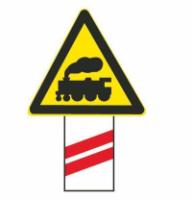
A. a manned level crossing 50m ahead
B. an unmanned level crossing 100m ahead
C. a manned level crossing 100m ahead
D. an unmanned level crossing 50m ahead
Answer:B
25. When driving in icy and snowy weather, ________.
A. The braking distance becomes longer
B. The resistance to slide becomes larger
C. The braking performance does not change
D. The road grip becomes stronger
Answer:A


